
So you're thinking about buying a vintage knitting machine. That's exciting! These machines are incredible — they can produce beautiful garments in a fraction of the time it takes to hand-knit. But they're also 30 to 60+ years old. Some are in amazing shape. Some are expensive doorstops.
I'm a knitting machine technician. I service these machines every day, and I get asked "is this a good deal?" more times than I can count. This guide is everything I'd tell you if you were standing next to me at an estate sale, looking at a machine and wondering if you should buy it. The TL;DR is that "It Depends".
This post is not a complete guide by any measure. I don't even cover plastic bed machines and lots of variations.
It is important to think about what yarn you want to use, what you want to make, how much of your own maintenance do you want to do on your own, can you witness the machine working, where you live, what is rare on local markets in your area and most importantly, what condition is the machine in at sale time.
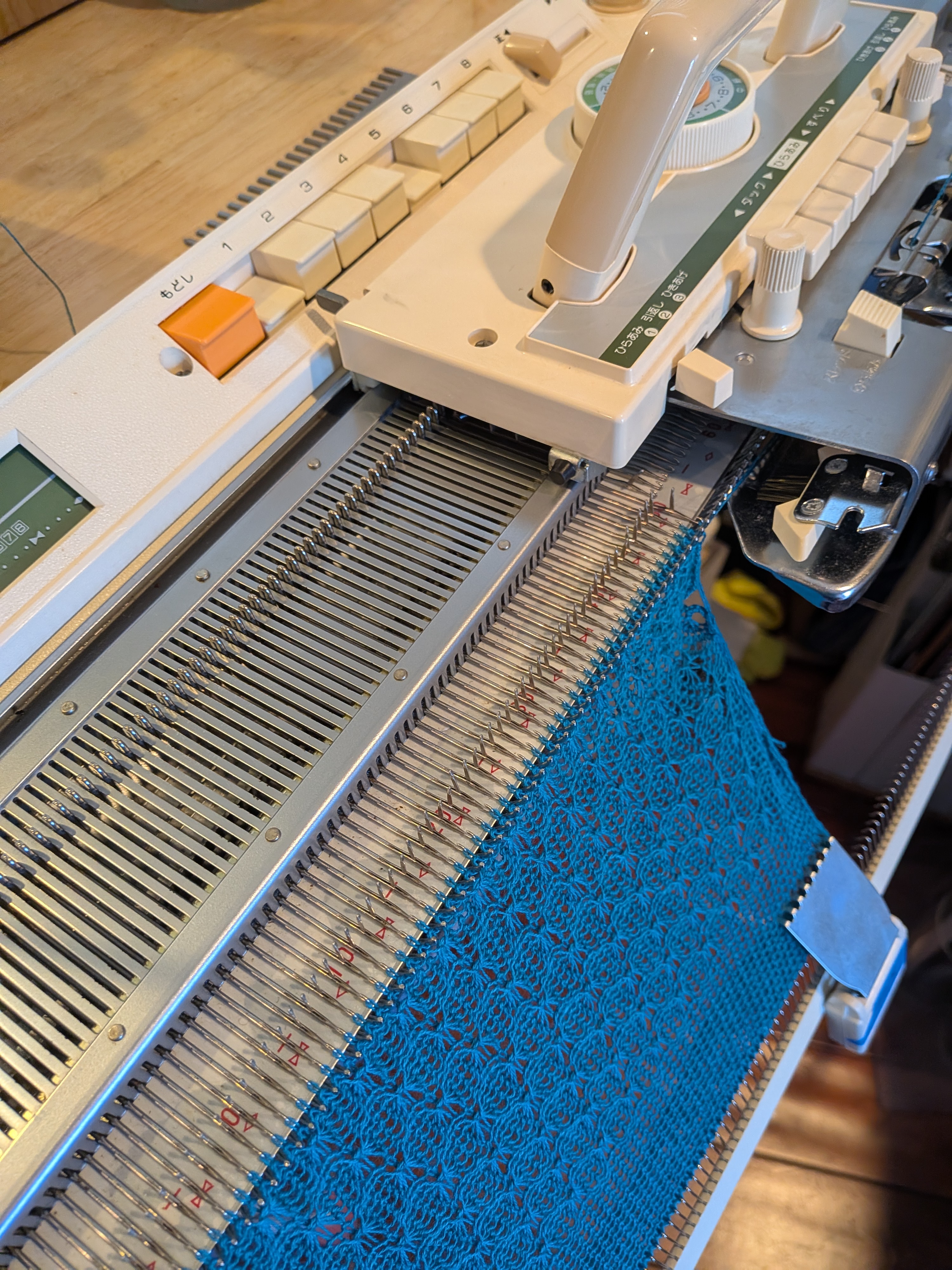
What Kind of Machine Do You Need?
Before you start shopping, figure out what you want to knit. The machine comes second.
Gauge Types
| Gauge | Notes |
|---|---|
| Standard | Most common, 4.5mm spacing for needles, thinner yarn than craft store yarn. |
| Bulky / Chunky | 9mm spacing on larger needles, thicker yarn, faster results, great for beginners. |
| Mid-Gauge | Less common, harder to find tools, can be around 6mm spacing depending on brand. |
| Fine Gauge | Very fine gauge, typically 2.5-3.5mm spacing, for intricate work. Very fine yarn. |
Patterning: Manual vs. Punchcard vs. Electronic
Manual machines are the simplest. Fewer moving parts, fewer things to break. Great for learning the basics of machine knitting.
Punchcard machines let you knit patterns using punched plastic cards — no computer needed. The mechanical card reader is one more thing to check when buying, but they're workhorses.
Electronic machines can use mylar/cartridges/downloads/built-in patterns depending on model. More parts to maintain, requiring a little more caution with care and maintenance. Circuit boards, membrane keypads, and motors that haven't run in decades.
First machine? Start with a standard or a bulky Brother either with manual patterning or punch cards. They're common, parts are available, and they'll teach you almost everything you need to know. Silver Reed is still producing new machines as well if you want to start new. There are also clones that are newly made if you can find them.
Do You Need a Ribber?
A ribber is (usually) a second bed that attaches to the main machine and lets you knit ribbing, double-bed patterns, and circular tubes. It's a separate purchase, adds complexity, and doubles the things that can go wrong. Get comfortable with the main bed first. That said, if the ribber is already with the machine it's worth getting a matching set that has been aligned and used together.
The Big Brands
Most brands have clones and some models are very similar to each other with small differences. This is not an extensive list — Mighty Knitty Machines is a great resource for deeper research.
| Brand | Also Sold As | Notes |
|---|---|---|
| Brother | Knit King | Most common in my customer base. Best parts availability. Great starter machines. |
| Silver Reed | Singer, Studio, Knitmaster | Solid machines, different needle system. Good community support. |
| Toyota | — | Less common in my customer base. Good machines but parts are harder to source. |
| Passap | — | Dual-bed system. Steep learning curve. Devoted following. Not a beginner machine. |
Red Flags — Walk Away
Pass unless you know what you are getting into.
- Rust on the needle bed — surface oxidation maybe, but deep pitting means the bed is damaged beyond reasonable repair
- Bent needle bed rails — the bed itself is warped. This isn't fixable.
- Missing carriage — a replacement carriage for a specific model can cost as much as the whole machine, if you can find one at all
- Mice or pest damage — chewed wires on electronic models, nesting material inside the case
- Smoke or fire damage — melted plastic, warped parts, a smell that will never leave
- Missing parts with no photos — if the seller can't show you the carriage, sinker plate, clamps, and cords, assume they're gone
- Obvious case damage — visible cracks, dents, or other structural issues can indicate it was dropped, which can cause a host of issues. May be cosmetic, may be worse.
Yellow Flags — Fixable, But Budget for It
Proceed with Caution
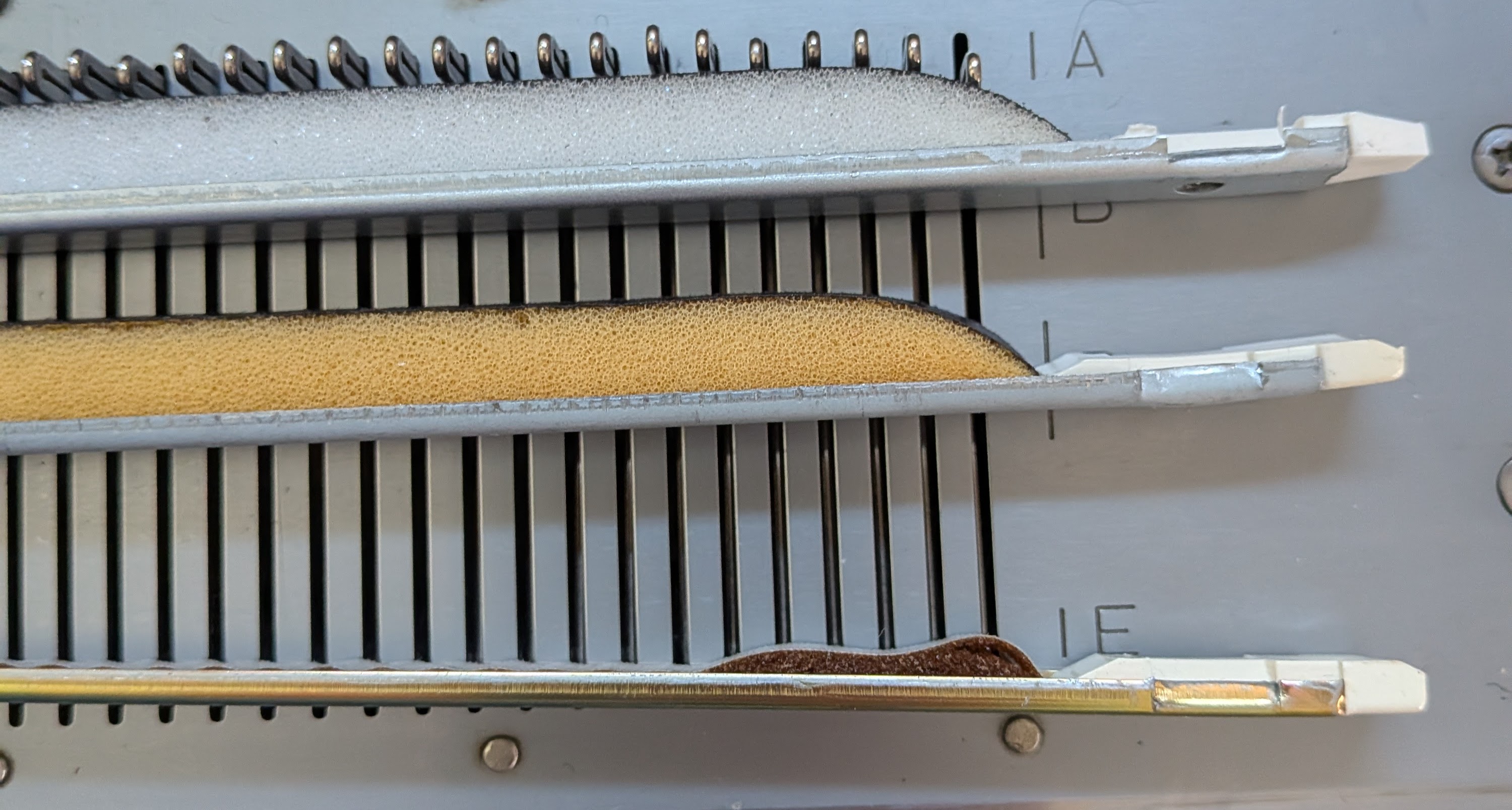
- Flat sponge bar — the #1 issue on every vintage machine. The foam strip that holds the needles in position compresses over time. Cheap to replace, but the machine won't knit until you do.
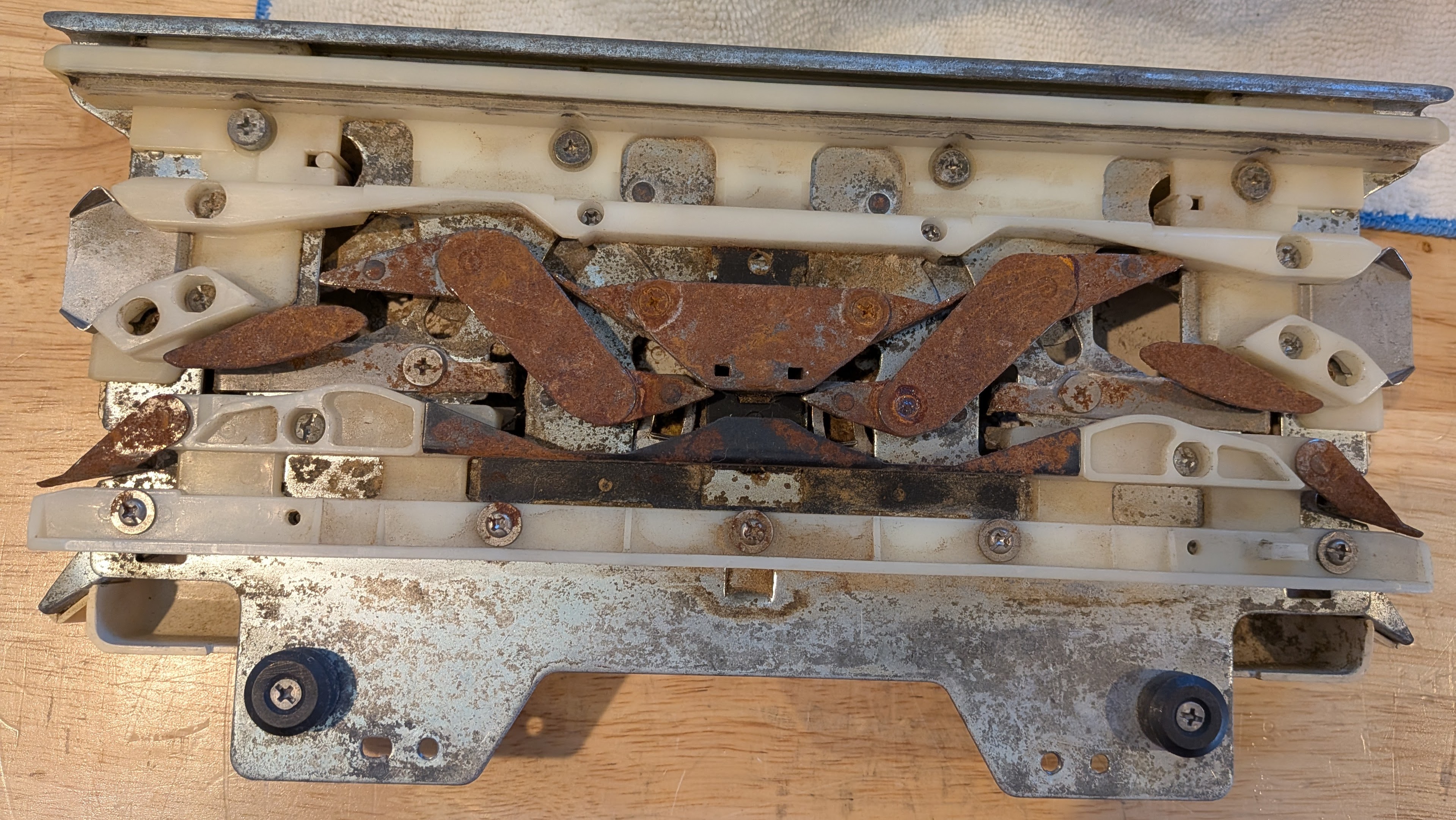
- Sticky, gummy carriage — old oil turns nearly solid after years of sitting. Needs a deep clean and re-oil. Very common, very fixable.
- Missing needles — replacements are available for most models. A few missing is fine. A full bed of missing needles adds up fast. At about $1 a needle you can easily add $200 to your purchase. Make sure the replacement needles are available to you.
- Dusty but complete — a machine that sat in a closet for 30 years but has all its parts is often a great find underneath the dust.
- No power cord (electronic models) — check whether the cord is proprietary or standard before you buy.
- Punchcard reader not advancing — usually a sponge bar or belt issue inside the carriage. Fixable, but it's a service job.
- "It worked last time I used it 20 years ago" — that is not a guarantee of anything
Green Flags — Good Signs
Looking Good
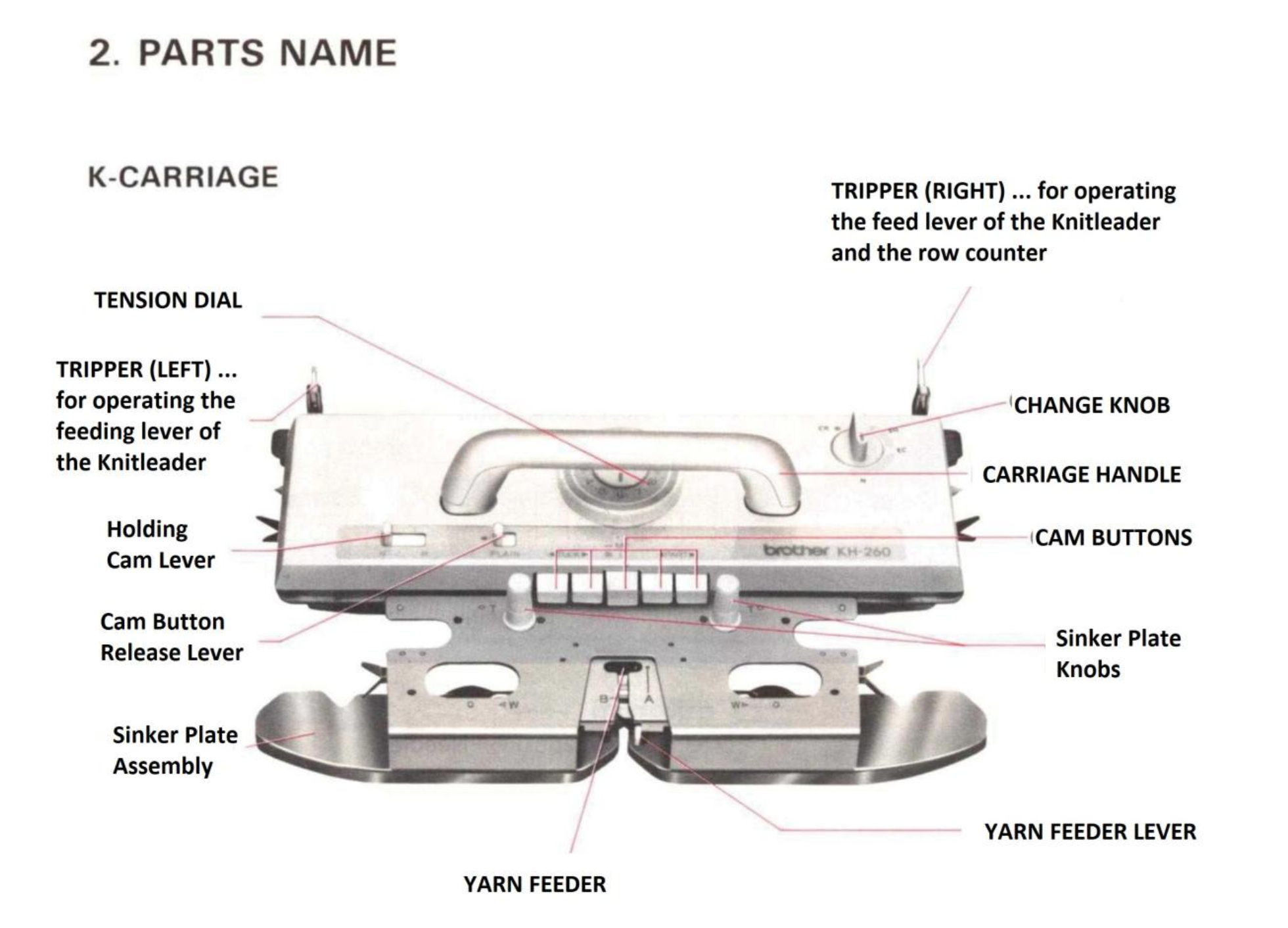
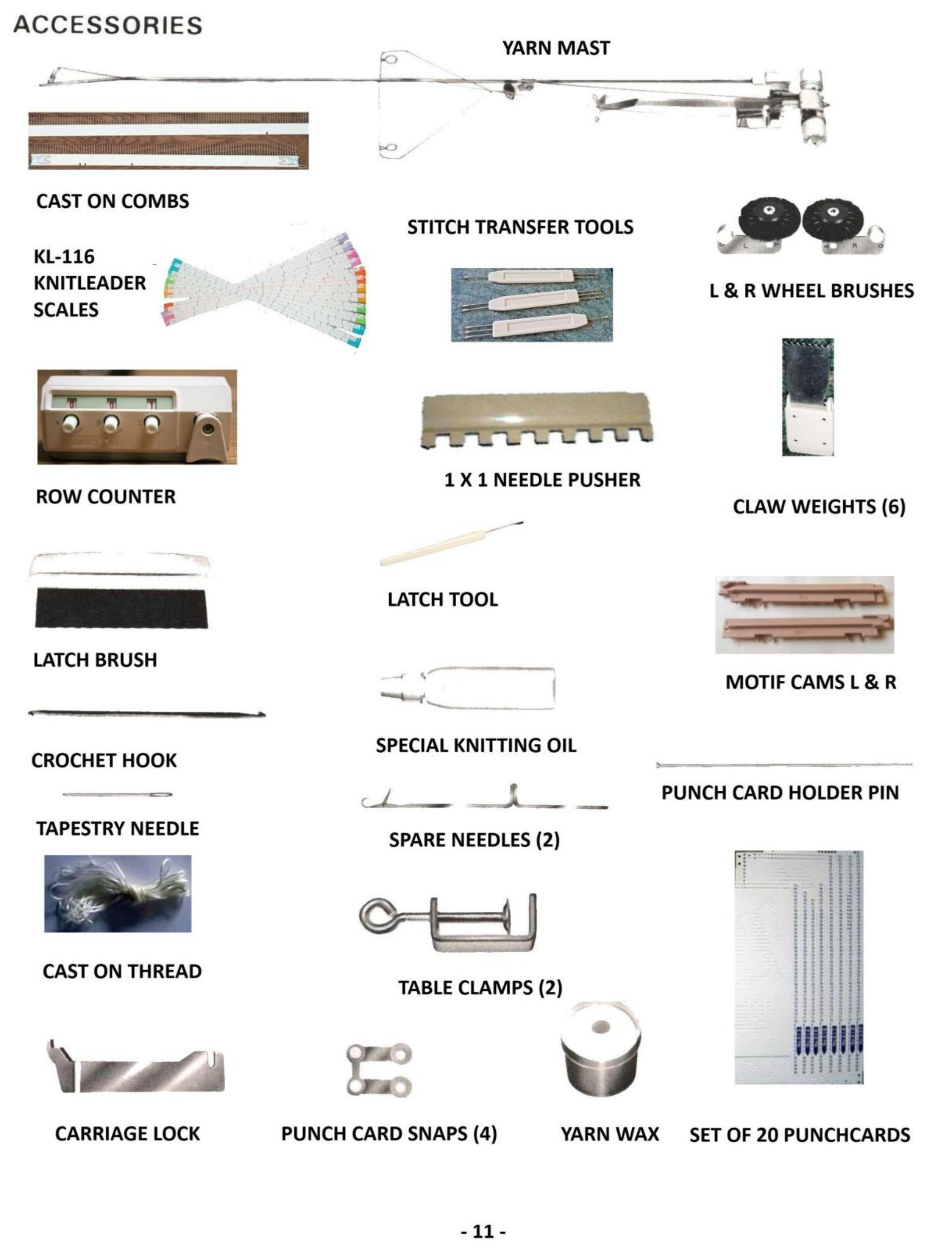
- Complete with accessories — ribber, lace carriage, garter bar, weights, clamps, tools. The more that's included, the better. Clamps, carriages, sinker plates, row counters, and lace carriages are model-specific.
- Original manual and/or punchcards included
- The seller knitted on it recently — even better if they can show you a swatch
- Stored indoors, climate controlled — garages and sheds can be machine killers
- Serial number visible — means it hasn't been rattled apart
- Original case or table — not required, but shows it was cared for, and cases can be surprisingly hard to find.
What to Ask the Seller
- Can I see close-up photos of the needle bed?
- Are the carriage and sinker plate included?
- Have the sponge bars been recently replaced?
- Has it been serviced? By whom? (Keep an eye out for "I tried to fix it but gave up" — I would ask for money off for this.)
- How was it stored? (Garage vs. closet matters a lot. Heat and sunlight as well as moisture are damaging to these machines and the vintage plastic parts)
- Why are you selling it?
- Do you have the manual, accessories, or extra needles? Manuals are mostly available to download for free at mkmanuals.com, accessories are often for specific models, so if they are found together it could add to your deal.
Pricing Reality Check
"What's a fair price?" depends on location, condition, completeness, and model. But here are some ground rules:
A machine that needs servicing or is obviously damaged should be priced lower. Factor in $100-200+ for a professional cleaning and sponge bar replacement by me; other mechanics may have different rates. If the seller is asking "works great!" prices for a machine that clearly hasn't been touched in decades, that's a disconnect.
A $50 machine that needs $200 can be a deal but if that same machine is $500 you can get outside your budget quickly. A $200 machine that's ready to knit is an amazing find.
Don't buy a machine you can't get serviced unless you are ready to take on a project yourself. Check if there's a technician in your area before you commit. A machine you can't maintain is a machine that will end up in a closet again.
Check out YouTube videos of the model you are considering for how to DIY service if that is your plan.
Estate sale machines are often underpriced but sold as-is. eBay and Marketplace machines are often overpriced because the seller googled the model number and found an optimistic listing. The actual value is somewhere in between, and condition is everything. On eBay be sure to check the location radius for where you live and try to look at what they are actually selling for in the past. Often the asking prices are not based in reality.
After You Buy
You got a machine. Now what?
Don't try to knit on it immediately. I know that's hard, but resist the urge.
- Replace the sponge bar — just assume it needs it. Almost every one does.
- Clean it — gently, starting with just sewing machine oil to break up old oil and grease. No need to jump right to harsh cleaners. Or better yet, have it cleaned professionally. Decades of dust, old oil, and fiber lint need to come out.
- Oil it properly — sewing machine oil. Never WD-40. I cannot stress this enough. WD-40 is a solvent, not a lubricant — it will strip rust protection rather than prevent it.
- Try a basic cast-on — a few rows of plain stockinette. Make sure everything moves before you attempt anything fancy.
- Read the Manual — work through it from the front. They really do tell you almost everything. If the manual doesn't work for you, search YouTube for your model number — I find "knitting machine, model number" to be effective.
- Find your local guild — knitting machine guilds are incredibly helpful, especially for beginners. They've seen everything.
The Bottom Line
A vintage knitting machine can give you decades of use if you start with the right one. Take your time. Ask questions. Look at photos carefully. Get the manual of the machine for sale and look for the pictures of the parts in the front of the book, compare to pictures on the listing.
Happy shopping, and happy knitting.
If you buy a fixer upper and need help fixing it, you can sign up for an appointment with me here
Or reach out at susan@makelively.com
For more resources, check out our Resources page